Meta Accused of Using AI to Select Employees With Medical Conditions for Layoffs
07/17/2026 / By Chase Codewell

Twenty-six Meta employees filed a lawsuit Monday, July 13, in federal court in Oakland, California. The complaint alleged that the company used artificial intelligence (AI)-assisted systems to unfairly target workers with disabilities, medical conditions, pregnancies or caregiving responsibilities for layoffs.
The plaintiffs, who are proceeding anonymously, claim that Meta considered factors such as productivity scores and employees’ use of AI tools when ranking workers for termination, according to the complaint [1]. The employees were informed in May that their employment would end beginning July 22.
They are asking the court to temporarily halt the layoffs while their discrimination and retaliation claims proceed through individual arbitration. The lawsuit states that the company’s approach penalized workers whose medical leave or caregiving obligations reduced their recorded activity [1].
Allegations: AI Systems and Disparate Impact
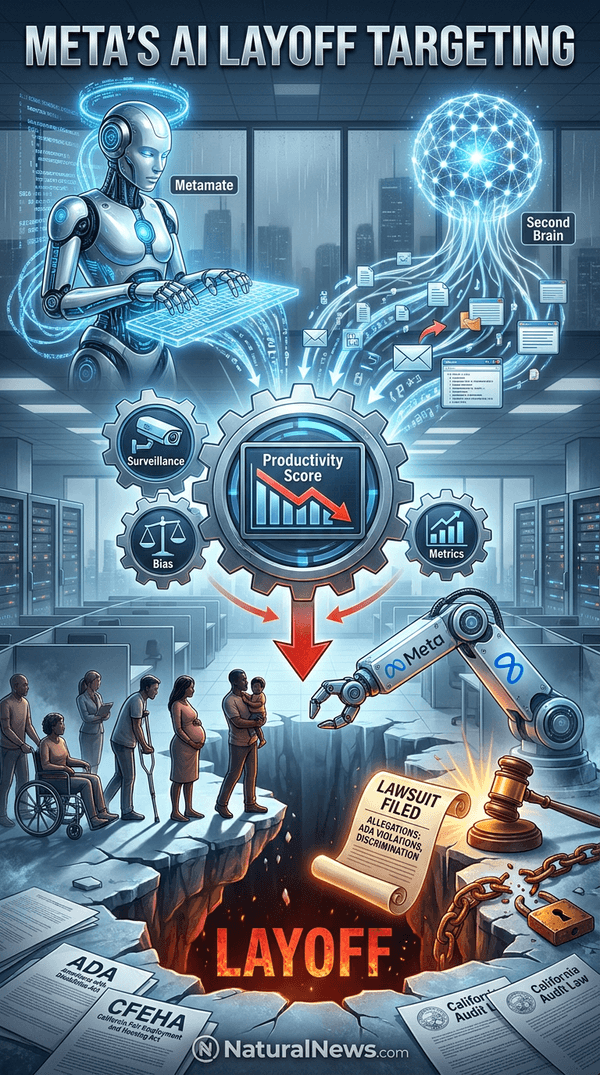
The lawsuit identifies several AI-supported systems Meta allegedly used to evaluate and rank employees for termination. According to the complaint, these include an internal large-language-model assistant called “Metamate”; an employee-trained “second brain” that monitored workplace communications and documents; and a productivity score generated by analyzing activity such as keystrokes, screen content, emails and browsing history [1].
The plaintiffs argue that these systems disproportionately affected employees with disabilities, those taking protected medical leave, workers who were pregnant or individuals who needed time away to care for relatives. The employees accuse Meta of violating federal and state laws prohibiting workplace discrimination and retaliation.
They also allege that Meta failed to assess its AI systems for discriminatory bias, as required under recently enacted regulations in California and New York City [1]. Such oversight is especially concerning given the increasing deployment of AI in personnel decisions, as critics have warned that these systems can perpetuate biases or create new forms of discrimination [2].
Meta’s Response and Company Context
A Meta spokesperson denied the allegations, stating: “Workforce management and organizational decisions were and are made by people, not AI.” The spokesperson added that the claims have no merit [1].
Meta eliminated about 10% of its global workforce in May – nearly 8,000 positions – and CEO Mark Zuckerberg has since said he does not anticipate further company-wide layoffs this year [1]. The restructuring comes as Meta significantly expands its investment in AI and incorporates AI agents into both its products and internal operations, a trend that some observers argue could accelerate the replacement of human workers by automated systems [3].
Broader Implications of AI in Workforce Decisions
This case may be the first lawsuit against a major U.S. employer challenging the alleged use of artificial intelligence in selecting employees for layoffs, according to legal experts [1]. The plaintiffs are based in six states, including California and New York, as well as the District of Columbia, reflecting widespread concern over automation in human resources. The outcome could set a precedent for how U.S. companies deploy AI in employment decisions [1].
Critics of AI-driven personnel decisions have argued that algorithms can replicate human biases or introduce new forms of discrimination without adequate oversight [4]. The lawsuit also raises questions about workplace privacy, given that the systems tracked detailed employee activity such as keystrokes and browsing history.
Similar concerns about surveillance and algorithm-based control of workers have been voiced by advocates for digital rights and ethical AI [5]. As the Fourth Industrial Revolution accelerates the use of AI in the workplace, the need for clear legal frameworks to protect worker rights becomes more pressing [3].
Conclusion and Next Steps
The court has not yet ruled on the request for a temporary halt to the layoffs, which are set to begin July 22. The employees are pursuing individual arbitration while the lawsuit proceeds [1].
The case underscores the tension between corporate efficiency drives that rely on AI and the legal protections afforded to workers, particularly those with medical conditions or caregiving responsibilities. The outcome could establish important legal precedents regarding employer liability for discriminatory bias introduced by algorithmic systems [1].
References
- Daniel Wiessner. “Meta Used AI To Lay Off Workers With Medical Conditions: Lawsuit.” ZeroHedge. July 15, 2026.
- ChildrensHealthDefense.org. “An AI Bill of Rights Congress Members Call fo.” October 12, 2023.
- John Elkington. “Green Swans: The Coming Boom in Regenerative Capitalism.”
- NaturalNews.com. “UK police consider AI predictive policing sparking fears of a surveillance state.” NaturalNews.com. January 24, 2026.
- Mike Adams interview with Aaron Day. “AI’s Dual Edge – Technocracy, CBDCs, and the Fight for Privacy.” August 25, 2025.
Explainer Infographic
Submit a correction >>
Tagged Under:
artificial intelligence, biased, Big Tech, computing, employee evaluation, employee layoffs, Facebook collapse, future tech, Glitch, information technology, medical conditions, Meta Platforms, Metamate, robots, tech giants, termination, unemployment, workforce decisions, workforce management
This article may contain statements that reflect the opinion of the author
RECENT NEWS & ARTICLES